



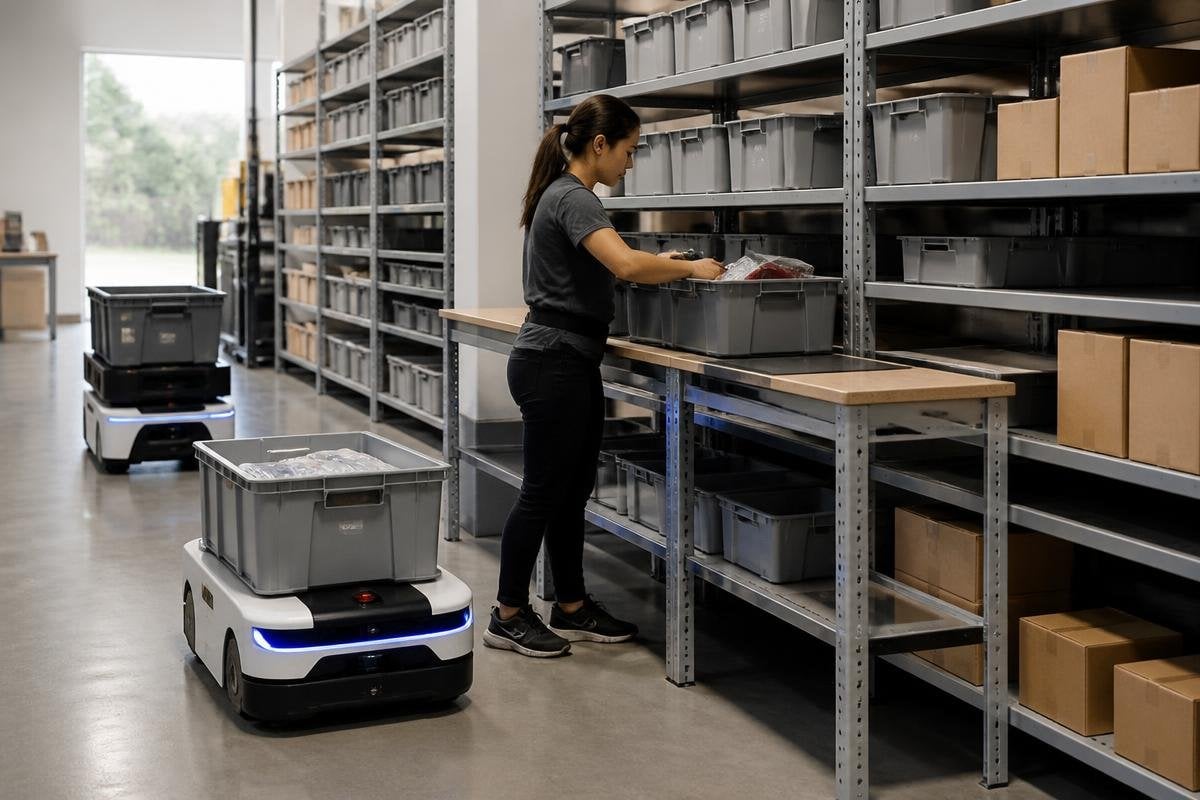
A micro-fulfillment center puts storage and order picking close to the customer, often inside or beside a retail site. Robots help because the space is tight, orders arrive one at a time, and staff need to find items without walking through a full warehouse.
- Robots bring storage bins to a picking station
- Software sends each order to the right work area
- People still check items, pack orders, and handle exceptions
Small sites have a walking problem
In a large warehouse, a picker can walk long aisles with a cart. A small site has less room for those aisles, so every shelf, turn, and work station must earn its floor space. A robot storage system can hold goods in dense racks and bring the needed bin to a person.
That changes the worker’s task. The person stays at a station while the robot moves inventory, which cuts the amount of walking needed for each order. The effect depends on the layout, order mix, and software, so a robot cannot fix a poor plan on its own.
The robot may use wheels, rails, or a lift to move under or beside storage bins. Sensors help it avoid people and other equipment, while a control system assigns jobs and tracks where each bin belongs.
The exact design varies, but the job stays the same: move the product to the person instead of sending the person to search for it.
Orders need fast item access
Micro-fulfillment sites often handle small customer orders. One order may need a few items from different parts of the store, then move to packing or collection. The system can call up several bins for one order, allowing the picker to work from one station.
That arrangement also helps when demand changes during the day. Software can place popular items in easier-to-reach storage positions and send less-used stock to other locations. Those choices matter because a delay at one picking station can hold up the next part of the order.
The system still needs accurate stock data. If the computer says an item sits in a bin but the bin is empty, the robot has moved the problem rather than fixed it. Staff need a clear process for damaged goods, wrong counts, blocked paths, and orders that need a substitute.
Those exceptions turn a robot project into a software-and-floor test. A report matters when it names the warehouse task, the software link, and the point where staff took over. Robot 24 can put those details beside the work that micro-fulfillment robots still leave with people.
Robots do not remove the hard parts
A compact site can make delivery faster by placing stock near the customer, but its small footprint leaves little room for mistakes. A blocked station, failed scanner, or robot waiting for a clear path can affect the next order in line.
People remain important at the points that are difficult to standardize. They can check damaged packaging, identify an item the camera cannot read, and decide what to do when a customer’s order changes. Robots handle repeatable movement well; they need clear rules and human help when the physical situation differs from the stored data.
Cost also needs a careful look. A site may need robots, racks, charging equipment, safety systems, software links, and service support. The right comparison is the full operating cost against the walking, storage, and order work the system replaces. A robot that moves bins well may still be a poor fit if the site lacks enough orders to keep it busy.
I’d choose robots for a micro-fulfillment center when the site has steady order work and a layout built around the robot’s movement. I’d keep manual picking for a low-volume store or a site with changing stock and no room for service access.
A practical buying check
Use these points before selecting a system:
- Map the floor: mark storage, packing, charging, fire exits, and staff paths before choosing the robot.
- Count order work: measure orders by hour and record how many items each order usually contains.
- Check item fit: list the size, weight, shape, and packaging of the goods the robot must move.
- Test the software link: confirm that stock counts, order changes, and blocked locations reach the robot system.
- Plan recovery: write down who handles a stopped robot, a missing item, and a damaged bin.
- Price the whole site: include racks, power, software, safety equipment, service, and staff training.
The next useful step is a short site study using real order records, real product sizes, and the actual floor plan. If those three pieces do not fit the robot’s movement, the center needs a better layout before it needs more automation.